
Major Emergency Management

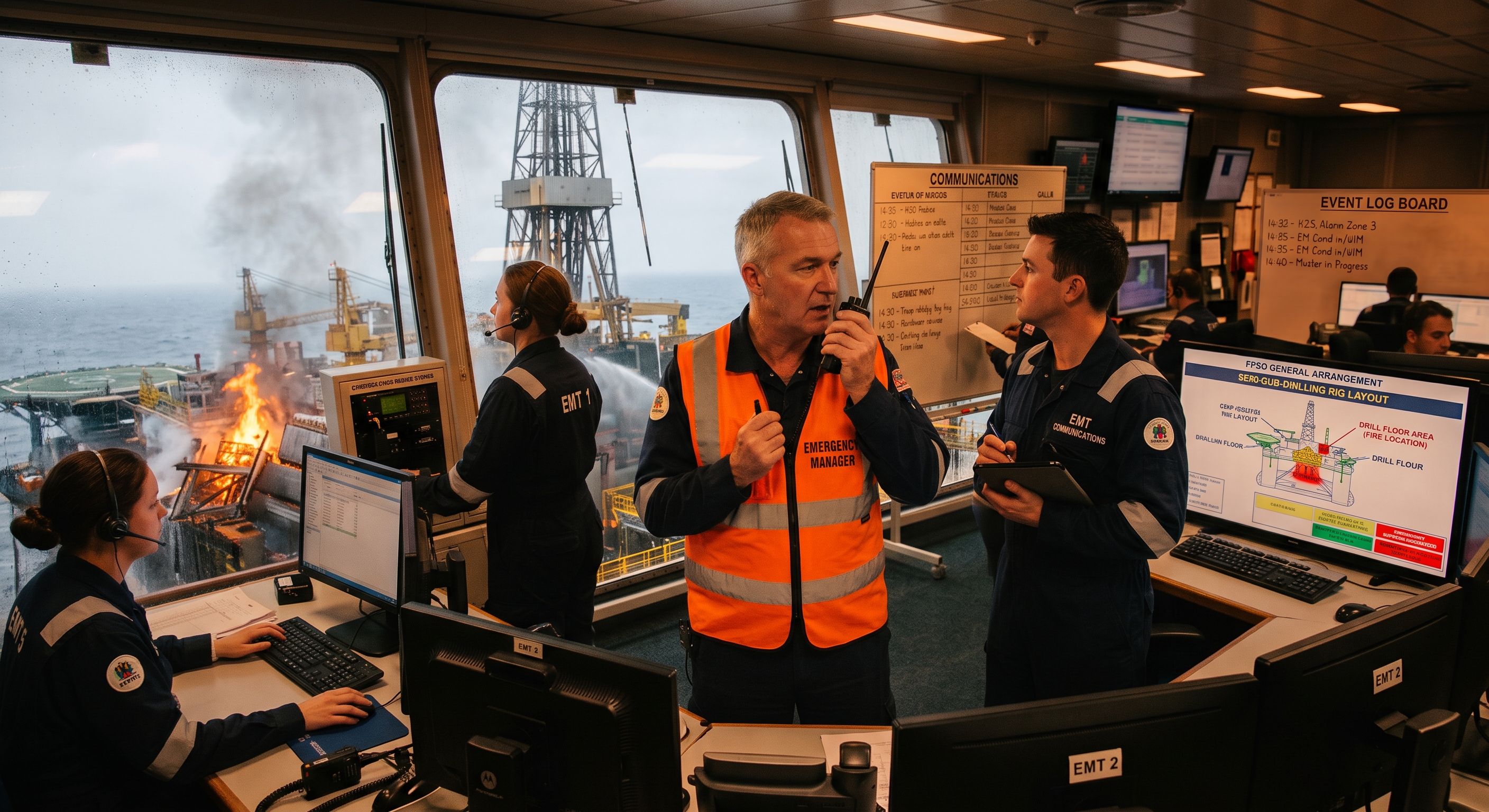
In the minutes between the first alarm and the arrival of external support, someone on board has to assess, decide and communicate. We prepare that person to international offshore industry standards, in a simulator, with scenarios based on real industry occurrences.

The interval that decides the outcome

A major offshore emergency is decided in a short interval: between the first alarm and the arrival of outside help. In that interval there is no hierarchy to consult and no time to convene a committee. Someone has to assess the situation with incomplete information, decide, and communicate in a way the team understands the first time. That competence is not acquired by reading a procedure, which is why the industry treats it as formal training, with its own standard and assessment. Vision Marine covers the full cycle with two complementary products, both aligned with international offshore industry standards.

Two products, different roles

The difference between them is simple: the first (MOME) develops the competence, and the second (PIC) attests that it exists. The most common path is to take both, in that order.

Builds

MOME, Major Emergency Management

An intensive initial response course. One day of theory builds the strategic perspective (types of major emergency, OIM responsibilities, Emergency Control Centre structure, stress management) and two to three days in the simulator put you to work under pressure, with feedback that includes what the team understood from what you communicated, which is usually different from what you thought you said.

Certifies

PIC, OIM Control of Emergencies Assessment

The assessment does not teach, it verifies. One day in a simulator that replicates the installation where the candidate actually works, with contingency scenarios and an assessor observing. At the end it is recorded whether they demonstrated the competence required by international offshore industry standards, and where they need to develop.

Available courses

Choose a course to see classes, prerequisites and conditions.

PIC — OIM Assessment in Emergency ControlOil & Gas

PIC — OIM Assessment in Emergency Control

Duration8h
View the course

Who it is for

For anyone who may be called on to command the initial response on board: Offshore Installation Managers (OIMs) and their deputies, Emergency Managers, area supervisors, response coordinators and members of the Emergency Control Centre. It also serves professionals preparing to take on those roles and onshore teams supporting the installation during a crisis, because the response only works if both sides speak the same language.

Why Vision Marine

International standards

Content and assessment follow the standard recognised internationally by the oil and gas industry, which is what makes the record accepted outside Brazil.

Simulator with real scenarios

Scenarios come from documented industry occurrences, and in the assessment the environment replicates the candidate’s own installation, not a generic platform.

Instructors from the operation

Those who run the training have been on the other end of the radio in a real emergency, and that is what supports the individual feedback after each scenario.

Closed corporate classes

The operation can be trained together, onshore and offshore in the same room, which is when the communication exercise starts to count for real.

Frequently asked questions

What is the difference between MOME and PIC?

MOME builds the competence to command the initial response, with theory and simulator practice. PIC is an assessment: it verifies and records whether the Offshore Installation Manager is competent, without teaching. Most candidates take MOME first and PIC afterwards.

Do I need MOME before PIC?

It is not mandatory, but it is the usual path. PIC assumes the candidate already knows the installation emergency plan and the control techniques the standard requires; without that foundation, a good decision in the simulator is luck.

Does the certificate expire?

MOME has no expiry date. PIC, being a competence assessment, is reassessed periodically according to the operator requirement and international offshore industry practice. Confirm with our team the requirement that applies to your contract.

Do you run closed classes at the company?

Yes, and it is the most effective format for this subject, because it lets the offshore crew and the onshore support team train together, which is exactly who has to understand each other over the radio in a real emergency.

Where are the courses delivered?

Yes. If the goal is to train the management team, MOME is the best solution: the scenarios and simulations can be tailored to the reality of your operation. If the goal is to assess the OIM’s performance in managing the emergency based on the company’s specific procedures, PIC is the recommended option, which can also be customized for the installation.

Prepare the person who will command

Tell us about your operation and your team profile, and we will advise the path between building the competence and certifying it.

Talk to a specialist